1/27/07

Rhythm: The Music of the Spheres

"Music is a hidden arithmatic exercise of the soul, which does not know that it is dealing with numbers, because it does many things by way of unnoticed conceptions which with clear conception it could not do. Those who believe that nothing can happen in the soul of which the soul is not conscious are wrong. For this reason the soul, although not realizing that it is involved in mathematical computation, still senses the effect of this unnoticeable forming of numbers either as a resultant feeling of well-being in the case of harmonies or as discomfort in the case of disharmonies."
Gottfried Wilhelm Leibniz

Rhythm is the basis of harmonic proportions and intervals, fundamental physical mechanisms. This harmonious equilibration was expounded upon by Pythagoras, father of Philosophy. Pythagorean thought formed the basis of the philosophy of Plato, and later Neo-Pythagoreans and Platonists, and greatly influenced the development of western science.

Pythagoras laid the foundation for a holistic science which integrated spiritual, ethical, and metaphysical, as well as practical techniques. Pythagoras is famous for his axiomatic viewpoint that "there is geometry in the humming of the strings. There is music in the spacing of the spheres." From Plotinus we hear, "All music based upon melody and rhythm, is the earthly representative of heavenly music."

And from Sufi Hazrat Inayat Khan,

"When one looks at the cosmos, the movements of the stars and planets, the law of vibration and rhythm, all perfect and unchanging, it shows that the cosmic system is working by the law of music, the law of harmony; and whenever that harmony in the cosmic system is lacking in any way, then in proportion disaster comes to the world, and its influence is seen in the many destructive forces which are manifest there. The whole of astrological law and the science of magic and mysticism behind it, are based upon music."

Pythagoras systematized the laws which allow the creation of stringed instruments: musical scale intervals (octaves, fifths, fourths, thirds). He recognized that these fundamentally abstract relationships pervade all creation--even matter irself. In music, as in nature, a wave is a shape in motion. Each note has a wave-shape.

The octave comes from exactly doubling, or halving the string length, that is in 1:2 proportion, while the harmonious fifth has a 2:3 ratio and the fourth 3:4. There is also the less obvious 4:5 interval of the third, and even less obvious consonances.

Any tone in the overtone scale is higher than the preceding tone by precisely one whole number. These are the so-called harmonics. The lower the proportions of the numbers, the stronger the consonance, the more harmonious the sound of the two tones together. The primal polarity ratio of 1:2 is the most harmonious to our ears which are biologically geared to seven basic laws of harmony based on the primal law of whole-number quanta (which prevails in physics as well as music):

THE SEVEN LAWS OF HARMONY

1. the overtone scale

2. the interval proportions

3. the division of the octave into twelve semitones

4. the difference between consonance and dissonance, the consonance growing as the proportion of the numbers gets smaller

5. the difference between major and minor, the major proportion being the most frequent by far

6. the predominance of the 1:2 polarity, the octave

7. the law of the Lambdoma (a column of numbers written in the form of the Greek letter lambda, whose right leg consists of whole numbers going from one to infinity while the left leg contains the fractions of these same whole numbers, so that the coordinates of the open isosceles triangle follow the scale of overtones or undertones). There are correspondences in physics, acoustics, arithmatic, geometry, crystallography, cybernetics, theology and philosophy, the genetic code and I Ching.


The Mysticism of Sound: Music, The Power of the Word, and Cosmic Language (Sufi Message of Hazrat Inayat Khan Ser: Vol. 2)

Max Beckman- 'On My Painting'


"My aim is always to get hold of the magic of reality and to transfer this reality into painting -- to make the invisible visible through reality. It may sound paradoxical, but it is, in fact, reality which forms the mystery of our existence.
What helps me most in this task is the penetration of space. Height, width, and depth are the three phenomena which I must transfer into one plane to form the abstract surface of the picture, and thus to protect myself from the infinity of space. My figures come and go, suggested by fortune or misfortune. I try to fix them divested of their apparent accidental quality."


"When spiritual, metaphysical, material, or immaterial events come into my life, I can only fix them by way of painting. It is not the subject which matters but the translation of the subject into the abstraction of the surface by means of painting. Therefore I hardly need to abstract things, for each object is unreal enough already, so unreal that I can only make it real by means of painting."

"In my opinion all important things in art since Ur of the Chaldees, since Tel Halaf and Crete, have always originated from the deepest feeling about the mystery of Being. Self-realization is the urge of all objective spirits. It is this Self for which I am searching in my life and in my art.
Art is creative for the sake of realization, not for amusement; for transfiguration, not for the sake of play. It is the quest of our Self that drives us along the eternal and never-ending journey we must all make."

"Color, as the strange and magnificent expression of the inscrutable spectrum of Eternity, is beautiful and important to me as a painter; I use it to enrich the canvas and to probe more deeply into the object. Color also decided, to a certain extent, my spiritual outlook, but it is subordinated to light and, above all, to the treatment of form. Too much emphasis on color at the expense of form and space would make a double manifestation of itself on the canvas, and this would verge on craft work. Pure colors and broken tones must be used together, because they are the complements of each other."

Excerpts from the lecture , given at the New Burlington Galleries, London, in 1938. (source: Herbert)

Max Beckman

1/23/07

Carlos Valdez senior and Matisse


Being the only son of a painter I grew up listening to my father's ideas about the mystical experience of art. As a kid I was bored out of my skull when he would start rambling on and on about art, but as I grew older I realized that pops had given my a pretty good artistic education. I just applied everything he talked about to Jazz music. It would behoove every Jazz musician to take some time to study the writings of the masters. Visual artists often have more developed philosophic concepts about the artistic process. There are many books by painters that have profoundly influenced my concepts of music.

A few of these books are:
Concerning the Spiritual in Art
by Wassily Kandinsky,

Kandinsky: The Art of Abstraction


Here's a note my father sent me about abstract expressionism. Carlos senior could be described as an abstract expressionist painter, so here's what he has to say about one of his favorite painters- Matisse.


"You mentioned being an abstract expressionist player-

So what if a line bleeds through or some canvas shows?

Matisse worked those elements intuitively, brought them along with the rest of the painting.

They had as much rich distilled feeling as anything else in the painting.

Did this make the painting complex? no

Matisse
condensed his elements fantastically- some wonderful works are nothing
but a few scratches.

He said that he wanted an art free of all troubling subject matter-
what he really wanted was to be in his oriental paradise, and he did get there.

Imagine decades of
that experience of beauty.

He called it in his characteristically concise way- expression.

I can't
understand how he was ever recognized-his work is so subtle.

Contemporaries talk
of seeing him scrape away works of fantastic beauty- that's not what he was after.

He said that
he experienced god at those times when he did something that he was not capable of, but he felt cheated that that was as close as he could come.

I found this Matisse quote-
"Instinct must be thwarted just as one
prunes the branches of a tree so that it will grow better."

but you know he got his major jollies when he worked-intuitively.

Maybe he meant something different than it seems.

I think that Matisse followed the sense of what mattered to himself in his art no
matter what.

He learned everything he could about painting then simply left himself open to what might happen.

He was suicidal at times in despair over being unable to do what he needed to d
o. He lived through 2 world wars where artists were starving- but if he could identify with it it stayed in. This can be seen in the work just after the fauvist period. Once that was solidly established, which I believe involved cultivating his nervous system as a tibetan monk would do- through the practice of painting.

He went to the light and ultimately transcended himself.

The matisse flower is actually a tamed demon.


1/19/07

Liner notes for my new CD w/Pere Soto

Tim Price wrote the liner notes for Oasis, my new CD project with guitarist/composer Pere Soto. We're still shopping the CD to European record labels and have a few leads so far. We found a record label that really likes, but can't afford the advance we need. They are acting as our agent at the MIDEM international music industry convention. I'm just trying to be patient.
I wanted someone who really understood my playing to write the notes. Tim knew all the teachers I studied with. I also felt that he really appreciated the direction I was headed as well as the musical influences that had shaped my playing. He have been trading our music for years but have never met in person. I'm very happy with how the liner notes turned out. He really understood what we were trying to do with this CD.

"When one considers what makes a meeting of two master musicians interesting, there are several common factors that can be observed throughout the history of jazz. The interest is found in the contrast between a common vocabulary and lineage but interpreted individually which of course is one of the main facets of jazz. In other words, there is enough similarity for some semblance of a unified approach, but at the same time enough differences to attract interest. With David Valdez and Pere Soto the unity and differences are clearly demonstrated.
Stylistically, David and Pere approaches are very distinct. They both stretch the rhythm and harmony, but in completely different ways. David seems to slip and slide around within the framework of a tune in with a wide range of articulations and intervallic choices. He plays with the beat creating a kind of spiraling vortex of sounds. One of the very best modern day alto players!

Pere Soto dives straight into the center of the harmony and pulse using his
incredible imagination to create a universe of its own within the structure of the tune. Speed and dexterity are fundamental to his style .Ya know, when I close my eyes and listen to him, it’s amazing.

Finally, there is the sheer joy and camaraderie the David Valdez and Pere Soto of playing and listening to each other. Classic! This disc is stellar and packed with just the kind of experience needed, which is to the advantage of the listener because it brings a relaxed informality to the recording.

Pere in his own wa
y has extended the language on his instrument to a level prominent enough to have a major effect. It has been my feeling that with our culture's emphasis upon and rewarding of conformity rather than originality has been increasingly stifled in the past decade or so. You won't hear that stifled approach here! In his playing you hear the history of jazz!

David Valdez can do so much and has always struck me as rather distinctive on that level as well. He tends to go more directly head to head inside the music. Maybe this translates musically to more chances taken, more densely packed lines, more roughness and use of combinations in the sound.

Most of these tunes allow the artists to use their common language, as a vehicle for creativity and self-expression. It is a vital source of listening experience, I've known Valdez for years musically, and his playing is a vital asset to this music. This disc combines a kind of textural austerity with the sometimes forbiddingly jagged melodies that just make you return to it daily, the results are very attractive.

This new recording by these two modern day masters is a step in a well-needed direction. This excellent project brings together highly respected players whose paths have crossed before in various configurations over the years. As a unit, they authoritatively and creatively play the music on this disc with great personal integrity coupled with intensity and energy, formidable chops and intelligence that recalls the forward thinking.

Hear It! It is something very special.

Tim Price

Here is a link to the title track Oasis.

Cannonball Spectacular!

This Cannonball transcription site is out of control, truly amazing, and totally Kick-ass, unless of course you don't love Cannonball. Doc Stewart put these solos together. Doc has a Cannonball tribute band and he actually plays the transcriptions.
Nice work Doc, thanks!

THERE ARE 263 Cannonball TRANSCRIPTIONS ON THIS SITE!!!!!!!!

"This page is a comprehensive list containing the title and recording date of every RELEASED song - past or present - that Cannonball Adderley plays a solo on. The following recordings were/are available in either LP, EP, 45rpm, CD, DVD, casette, 8-track, or VHS formats. If the song name is in red, that means the recording exists but I haven't found it yet. Black means I have the recording. Links are provided to some of my transcriptions and session tables."

I found this on Steve Neff's site. Steve has just started a very promising Jazz blog, and has some nice material on his main site, like clips of him playing lots of different mouthpieces (including a nice early Babbit Link I recently sold him).

1/14/07

Michael Brecker Dies at 57, the voice of the modern saxophone

Published: January 14, 2007
New York Times

Michael Brecker, a saxophonist who won 11 Grammy Awards and was among the most influential musicians in jazz since the 1960s, died yesterday at a hospital in New York City. He was 57 and lived in Hastings-on-Hudson, N.Y.

The cause of death was leukemia, said Darryl Pitt, his manager.

Having taken a deep understanding of John Coltrane’s saxophone vocabulary and applied it to music that merged with mainstream culture — particularly jazz fusion and singer-songwriter pop of the 1970s and 80s — Mr. Brecker spread his sound all over the world.

For a time, Mr. Brecker seemed nearly ubiquitous. His discography — it contains more than 900 albums — started in 1969, playing on the record “Score,” with a band led by his brother, the trumpeter Randy Brecker. It continued in 1970 with an album by Dreams, the jazz-rock band he led with his brother and the drummer Billy Cobham.

His long list of sideman work from then on wended through hundreds more records, including those by Frank Zappa, Aerosmith, James Brown, Paul Simon, Joni Mitchell, Lou Reed, Funkadelic, Steely Dan, John Lennon, Elton John, and James Taylor, as well as (on the jazz side) Chick Corea, Pat Metheny, Gonzalo Rubalcaba, and Papo Vasquez. His 11 Grammys included two for “Wide Angles,” his ambitious last album, released in 2003 with a fifteen-piece band he called the Quindectet.

His highest achievements were his own albums, both under his own name (starting in 1986) and with the Brecker Brothers band, as well as his early 80s work with the group Steps Ahead. Mr. Brecker was scheduled to tour with a reunited version of Steps Ahead in the summer of 2005 when his condition was publicly announced — initially as myelodysplastic syndrome, a bone-marrow disorder, which finally progressed to leukemia — and much of his work had to stop.

Mr. Brecker grew up in a musical family in Philadelphia; his father was a lawyer who played jazz piano. He started playing the clarinet at the age 6, switched to alto saxophone in the eighth grade, and finally settled on tenor saxophone in the tenth. He started to attend Indiana University — as did his brother Randy. After initially pursuing a music degree and then briefly switching to pre-med, he quickly discovered he preferred to be playing music. He left for New York at 19.

For most of the 1970s and through the mid-80s he worked hard in studio sessions, becoming a fixture on albums by the Southern California pop singer-songwriter movement, including those by Jackson Browne and Joni Mitchell. But for hard-core jazz enthusiasts, it was his work of the early 80s — on Steps Ahead’s first two albums, when the band was simply called Steps — as well as Chick Corea’s “Three Quartets,” from 1981, and Pat Metheny’s “80/81,” from 1980, that cemented his reputation as a great player.

His tone was strong and focused, and some of his recognizable language echoed Coltrane’s sound. But having worked in pop, where a solo must be strong and to the point, Mr. Brecker was above all a condenser of exciting devices into short spaces. He could fold the full pitch range of the horn into a short solo, from altissimo to the lowest notes, and connect rarefied ideas to the rich, soulful phrasing of saxophonists like Junior Walker.

In the 1980s and 1990s he experimented with the electronic wind instrument called the EWI, which allowed him to blow through an electronic hornlike device, play a range of sampled sounds, and multitrack them in real time. He began experimenting with the instrument again in the last few years.

With the onset of his illness, he and his family called for bone-marrow donors at international jazz festivals, synagogues, and Jewish community centers around America; tens of thousands responded. Working sporadically over the last year, he managed to complete his final album two weeks ago, Mr. Pitt said.

He is survived by his wife, Susan, of Hastings-on-Hudson; his children, Jessica and Sam, of Hastings-on-Hudson; his brother, Randy, of Manhattan; and his sister, Emily Brecker Greenberg, of Philadelphia.

1/6/07

Django's Castle videos

My partner in crime Pere Soto just posted a bunch of videos on YouTube of his Gypsy Jazz project Django's Castle. Check out his two fingered version of Nuages to get an idea of what Django was working with.

Pere Soto plays Django

1/4/07

More Slonimsky questions...

Q: Carlos,
Hey, can you elaborate more on this idea of "resolving" your harmonic lines? Obviously things like taking the leading tone of a dominant to the tonic make sense to me, but in your last email regarding Slonimsky you said the following....

"Just make sure you resolve them strongly, you'd be amazed what you
can actually get away with and still sound good."

and ..

"Tonal harmony is after all mainly about forward motion, so the lines
found in TSMP offer away to still retain forward motion while playing
outside. It just becomes a matter of being able to resolve these
lines in a logical way...."

A: Charles McPherson has an exercise that he makes his students do. He has them play totally outside over dominants and then land on a strong chord-tone on beat one of the next resolving bar. He says if you resolve on the downbeat with a strong chord tone you can play anything and it will sound like Bebop. This is just about true, even though it does sound quite extreme.

Q: Related question.....do you use diminished stuff freely against dominants resolving to both Major and Minor, or just for dom's resolving to Major? I've heard both suggested....and can you specifically tell me how you resolve a diminished scale, like do you actually try to resolve each dissonance (flat 9, sharp 9, sharp 11....) or just go to the Lydian mode/melodic minor of the tonic and leave it at that?

A: I do use diminished modes when resolving to major or minor chords. To determine what chord-scales are available I only look at the root motion of the chord that the dominant resolves to. If the root motion is going down a fifth (up a fourth) then anything is fair game, no matter what chord quality the resolution is. Yes, there are scale choices that are smoother as far as voice leading when resolving to a minor chord, like a harmonic minor scale from the fourth or and altered dominant scale.

Remember that if the dominant chord is moving down a half-step in root motion you only should play a Lydian dominant (even if the #11 isn't notated) because it is functioning as a tritone!

Berklee teaches that certain tensions are available for each of the secondary dominant chords:

V7/II b9, 9,#9, b13
V7/III b9,#9, b13
V7/IV 9, 13
V7/V b9, 9,#9, 13
V7/VI b9, #9, b13

The most important thing is to watch for root motion! Where do the dominants move to?
Don't worry about resolving individual tensions, this will drive you nuts and slow you down.
Some people would argue with me, remember I consider myself a post-bop player, which to me is like an abstract expressionist painter. The rules are a bit more relaxed and I'm looking to use a more 'painterly technique', I don't want photo-realism in my playing. So what if a few lines bleed over or if some canvas shows? You could follow stricter rules than I do as far as finding scales for chords, but mine keep you out of trouble and I can always break them if they get too constraining.


Q: Also, other than Bird, what specific solos would you prescribe for an intermediate level aspiring improviser on alto to learn by ear and transcribe? How about tenor?

A: I usually get intermediate level students working on Sonny Stitt transcriptions, both alto and tenor. Stitt is very clear rhythmically and he has nice long lines. Early Phil Woods is also a good altoist for transcription, the Phil and Quill records.

Q: And what about more advanced concepts,
are there some specific examples you could point me to for my students that aren't too long or too fast but that would show in detail some specific stuff. Most of the stuff I have them do is Bird and Lester, but you don't get into more far out harmonic stuff with them. Some I've graduated to Dexter, but I'm trying to get them onto some newer material. Cannonball? Who else and what else?......If you could toss out a handful or so that would be great....

A: How about Dick Oatts, Grossman or Rick Margitza for 3-tonic lines, Jerry Bergonzi for use of pentatonics and digital patterns, Kenny Garrett for triads and pentatonics used for outside playing. Try to find examples that are rhythmically straightforward, since complex rhythmic figures are the bane of young transcribers.

Q: Also, the Gary Campbell article is great on the blog, and I've seen the book. I seem to remember it being detailed but mostly covering the triad pairs being practiced up and down in their various inversions. Are there other ways to use these that sound good?

A: Gary does offer many examples of situations for triad pairs in his book. Triad pairs can also be used to play outside. Kenny Garrett does this very well. You can use one triad that fits the chord alternating with a triad that doesn't fit at all, this slips you in and out of tonal harmony.
Triads are so strong that they can supersede any chord progressions. Once you learn to create lines that shift inversions as they move between triads you can then use these lines to navigate outside harmony. Triadic lines are so strong that you can use them over any changes regardless of how they fit over the changes.


Q: Also, I worked with one of my former students who's in the jazz program at USC yesterday, he's now studying with Jason Goldman. Ever heard of this guy? Anyways, my kid was using the bis key for b flats exclusively, so I questioned him about it. He said his teacher told him to do it this way. So, since you do the same, I ask you, is this orthodox technique? I make my students master the side b flat, particularly for chromatic stuff, and then show them how to use the bis for leaps, like g minor or b flat major. Isn't that the way it's generally taught? What did Viola teach?

A: Joe V taught the use of both for different situations. Joe had a very pragmatic approach to technical questions. He always want you to find the most comfortable and smoothest fingerings for any given situation. The less motion, the better. There is usually one fingering that is clearly mechanically and ergonomically superior, just slow things down, watch your fingers and see which fingering feels best.

12/30/06

The function of the Jazz musician, more esoterics..

An idea that has intrigued me over the years has been," what is the functional role of a musician in this society?". As musicians we tend to be more aware of the music we create or the environments we find ourselves in than what our essential function is.

By function I mean-

* What is my role in this social situation that I find myself ?
* What does the audience expect my music to do for them?
* How narrow are the limits on my actions in my role as a musician?
* How much can I affect the audience without them playing an active role?
* Should I being doing more than just trying to entertain?
* How much of my inner self should I reveal through my music, if any?
* Will they be aware if I change my function from minstrel to high priest?

I believe that a listener can only judge the functional role a musician is playing by the effect that the music has on them directly. The attitude of the musician determines the functional role he/she plays. How the musician see his own function as a musician can determine how much or how little the ego enters into the music. Function can change in the mind of a musician in an instant, and with it the profundity of the musical expression. A musician who believes their function is to create beauty will create music that is very different from a musician who's function is to pick up chicks.

If we look into the musical philosophies of ancient cultures we learn that their musicians were expected to play very different functional roles as modern musicians do. For them the role a musician was closely tied to the roles of the priest, healer, magician and seer. Music was never separated from it's related disciplines- astrology, medicine, mathematical cosmology,
geometry and ceremonial magic. To the ancient mind you could not understand one of these sciences without understanding all of them. In fact Hippocrates, the father of medicine, once stated that a doctor who didn't thoroughly understand astrology could do so much as even diagnose a patient. Music was always the thing that tied all the other sciences together and made them relevant to each other. It was the study of the manifested qualities of the whole numbers, in other words it was the foundation of qualitative mathematics. These qualities of the whole numbers, or integers, were the laws of musical harmony, but they were also the very laws of nature operating in the cosmos, on earth and in the psychological realms of the mind.
These laws of number/music became expressed in the construction of early alphabets, which were numbering systems as well as symbolic language capable of expressing abstract musical concepts. For example in the Hebrew alphabet each letting is a whole number and a whole number ratio, the first expresses it's relationship to the quality of an overtone, the second relates the letter to a musical interval. This is jumping ahead quite a bit, the point I'm trying to make is the general disparity in the way ancient civilizations defined the function of the musician compared to the way our society sees our role.

Consider the ideas that you were taught about the functional role that musicians play. Did you accept these ideas without first questioning them? Have your ideas about your function as a musician changed over time? How narrow or flexible are your ideas about function? How do you think these ideas influence the way you play music?

These ideas that we have about our functional roles can and do affect the music we end up creating, how we feel when we create music, and how people feel when they hear our music.

By making positive changes in our belief structures relating to music we can grow more musically than we could by wood-shedding for years, and the changes take affect in an instant. These changes affect the very nature of our musical expression by changing who it is making the music. Is that a ladies man playing Stella or a the high-priest of the sun?

Ok, Ok I'll go back to talking about how to play over two-fives............

12/29/06

Cosmic Music- Acoustic symbolism

Exerpts from ethno-musicologist Marius Scheider's essay 'Acoustic Symbolism',
from Cosmic Music-Musical keys to the interpretation of Reality', edited by Joscelyn Godwin.

"Of all the means for identifying oneself with the flowing of the cosmic rhythms, ancient ritual recommends music making as the best and most suited to man. Musical rhythm is unencumbered by any intellectual activity; it reaches down into our deepest unconscious because in it's empty form it constitutes the basis of that existence. It is the reality always operating in man, yet remaining inexpressible. Through music making one sets out on the path that leads to participation (or as they say,"drinking") at the river of cosmic rhythms. And even if one does not reach the ultimate goal, i.e., the completely empty form, by this kind of musical meditation, one nevertheless senses the nature of this ideal, most subtle and fluid filling of the empty rhythmic form by sound. There is in fact no kind of form filling of a material or static kind that can match for truthfulness the acoustic individuation of the empty rhythmic form. The flowing primordial energy can never become as transparent in solid form as it does in the fluid, or in particular the acoustic form. Not only does music making reveal the first and most palpable filling of the empty form, it also provides direct experiences of the contact between matter and spiritually significant sound, because this sound also sets the body of the singer in perceptible vibration. In wordless song, and in playing musical instruments, primal energies become transparent through matter in the purest conceivable form. Music making is a borderline occurrence between the tangible and the intangible, whereby the intangible is actually produced out the tangible. If one considers that the ancient cosmologies had the intangible and the invisible precede the material and tangible, then one begins to understand the pre-eminent significance of music in cultic activity. Whereas the sonorous word of creation gradually becomes enshrouded by the mute matter it is producing, the ritual strives toward making mute matter resonant. Music making is a borderline occurrence between intangible sounds and tangible matter. Its cosmological position in the reddening dawn between light and darkness springs from this borderline nature.........."

"The role of music in the concrete world is that of a mediator. It is no longer a primordial sound, nor a natural one, because since the dawn of creation it has become a conscious, man made art. But the the material that it uses remains the sound that reaches deep into our dark subconscious. According to the sayings of ancient cosmologies, music's place of origin lies in the breath, in the soughing of the wind and the roaring of the water. The home of music is the reddening dawn. There it has its castle with that high tower which, as it says in the fairy tales, sometimes even reaches beyond the borders of dawn into the bright daylight. As a purely sonorous phenomenon, music music is the archetype of movement insofar as rhythmic sound forms the basic structure of the world. Since man is also rooted in this early cosmos, he preserves this substructure in his subconscious, where the archaic and the truthful are ever present. The rhythmic substructure is the anthropocosmic primordial memory. As an art music- particularly in its connection with language- is a mixture of truth and falsity, and if the falsity of daylight is not overcome, music will become a bearer of illusion."

Slonimsky saves the world

Q: "Is there a good way to practice out of the Slonimsky book? Do you
transpose that shit or just run over it in the key of C to get more ideas. It's very interesting but dense harmonically, I never considered all the different permutations that are there." Markos

Markos,
I've never gotten round to transposing the Slonimsky material. The 1:6 are whole to
ne, 1:4 diminished and the 1:3 can be used over whole-tone or three tonic progressions, each one of those already cover several keys. The diminished and whole-tone patterns are cool because they are based on the scale but not all the notes are diatonic to the scale. That makes them close enough to use in place of a whole-tone or diminished scale. Remember also that as long as you move a pattern in minor thirds or whole-steps it sounds like diminished or whole-tone respectively.

The 12-tone patterns don't need to be transposed either. You just need to land on a good note when they resolve. This is because they have no key center, just a powerful gravity to the final tone. In fact you can really think of all symmetrical scales as having a strong dominant function, so you can get pretty wild and loose with them. Just make sure you resolve them strongly, you'd be amazed what you can actually get away with and still sound good.

Another way I like to practice from the book is to read through in a loose manner. I might just follow the shapes of the lines but use different notes. TSMP is great for opening your ears up to new directional motion in lines. There are shapes in TSMP that you just don't run across in Jazz. It also can introduce you ways of covering larger intervallic space, the first scale in the book (the 1:2 tri-tone) is a good example of this. Watch out for the trap though that many players who practice out of TSMP too much fall into. This is the strong tendency to start your lines at the bottom of the horn and head to the top of the range before going back down. I call this the 'Slonimsky Roller Coaster Syndrome'. There is one of my peers in particular who does this all the time (who lives in NYC and is on the Verve label). This cat is a great guy and a truly fantastic player, but up-down-up-down thing really gets on my nerves. Take that book away from him!!!

I think what Trane and generations of players found in TSMP were lines that had so much forward motion that they could be used over ANYTHING. These lines are strong enough to make outside playing sound logical. Tonal harmony is after all mainly about forward motion, so the lines found in TSMP offer away to still retain forward motion while playing outside. It just becomes a matter of being able to resolve these lines in a logical way.

Later in the book there are some very exotic sounding pentatonic scales like the Javanese pelog scale, the Japanese Hira-Joshi scale and Scriabin's pentatonic scale from Sonata number 7. These all could be used over various types of C7 chords. They could also fit over other chords with a little ingenuity. All these exotic scales still sound uniquely exotic no matter what chords they are played over.

The Bi-tonal Arpeggios section of TSMP is a topic that has already been thoroughly fleshed out in Gary Campbell's Triad Pairs book. These pairs of triads offer a goldmine for the Jazz musician. For more on this topic see my Triad Pairs articles.

For me TSMP offers an entire new world of 'directional ideas'. The lines in TSMP snake, interweave, spiral, converge & diverge, jump, lurch, and infra-interpolate. Practicing this book will break you free of overly simplistic vertical/horizontal concepts of linear thinking. TSMP has been without a doubt one of the main modes of transmission of contemporary classical ideas to the Jazz world. There is still much in TSMP that has been untapped. Can you imagine what would Jazz sound like in thirty years if young players worked out of TSMP instead of David Baker's Bebop books???

12/28/06

3 more Sonny videos


Don't miss the three new streaming videos posted at Sonny Rollins.com .

The first one is Tenor Madness on the main page, this is the squirley yet still interesting late Sonny.

The second video is a 1981 version of Moriat (a.k.a. Mack the Knife), this one is a little less raw.

The last one is a Ralph Gleason interview with Sonny from 1963.

Mover called me tonight and was telling about his two hour phone conversation with Sonny on Christmas. Sonny's still on the road quite a lot, but Mover said Sonny has been in one of his reclusive periods since his wife (and manager) passed away.

12/10/06

The never ending quest, or the obsession......

I realize that I've really been lagging on my posting lately. Sorry to all my regular readers.

Well, I finished mastering my CD project and it sounds better. Mastering bought out each individual instrument, generally just giving everything more of a ring. Now the search is on for a record company to put it out. There is always the option of releasing it ourselves, and that would only be about $1500 more for manufacturing.
  • The important most things that you want a record company to do for you are-
  1. Get you press/reviews- you could also hire a PR company to do this for you if you want to independent. A good record company already has a network of press contacts that will at least take the time to consider writing up new releases.
  2. Radio airplay- you need a solid network of broadcasting contacts in place in order to get wide airplay. I've seen driven independent artists do a good job at this themselves too. There are a few companies that charge you a couple of hundred dollars, plus a few hundred CDs and postage to get your music directly to DJs and programmers. I've had other friends who have had good results this way.
  3. Distribution- It's sometimes nice to actually sell some disks at some point and you can't really do this without good distribution. CD Baby can only go so far. You can find distributors without being on a label, for the DYI types.
  4. Tour support/booking- In the Jazz realm this can be totally nonexistant, but many labels will work with booking agents to send bands around the festival circuit. Personally, I'm only interested in touring Europe, so this is what I'm looking for. It is said that only about five booking agents book almost all of the European Jazz festivals.
  5. Legitimacy- Look at the artist rosters of the labels you are considering. Are these artists going to make you look better or worse. These will be your label-mates and these folks will be what people think of first when they think of the label.
Right now I'm just sick of hearing the CD that I just finished. When people ask me if I'm happy with it, I can't help wanting to say that I'm sick of it and never want to hear it again. I've totally lost my perspective. All I hear is my poor articulation, out of tune notes, repeated phrases, and sloppy lines. Hopefully I will get over this phase, maybe not though. I've been giving mastered copies out to musicians I respect in hopes of getting a better perspective on the recording.
Enough of that.....

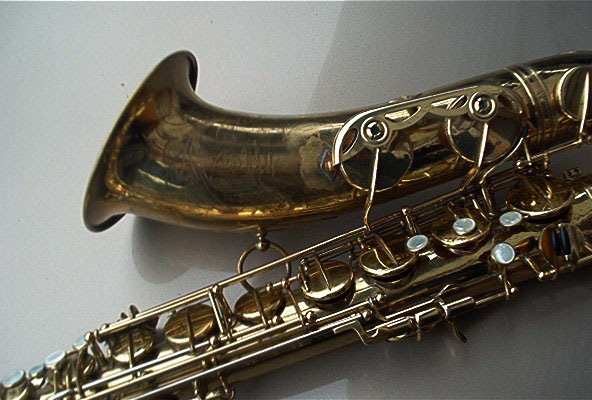
The real quest I want to talk about is the elusive quest for the perfect setup. For years all I played was alto. I've played the same slant Otto Link hard rubber 6 for 17 years and the same Vandoren Java 3 1/2 reeds for 23 years. My buddy Tom Pereira was the one who finally corrupted me. Tommy is a late stage gear addict. He looks at gold-plated five digit Mark VIs on eBay as compulsively as porn addict with a T1 internet connection. I'm sure everyone knows at least one saxophonist with this compulsion. They are never happy with their setup. Of course there are many variables to a saxophone setup; the horn, resonators, mouthpiece, neck, ligature, reed. Any of these factors can drastically affect the sound of the horn. I've heard that Don Mensa does a clinic where he dumps a pile of mouthpieces out on the table and then proceeds to play every one, sounding exactly like Don Mensa on each one. I know that for me there are very few pieces that I can sound good on, let alone be comfortable playing on. Getting back to Tommy, for years he suggested that I try other Mark VIs to solve the problems that I was having on my Starsky and Hutch era Mark VI. I finally gave in and found a horn that destroyed the horn that I was so very happy with for 15 years. I had found my holy grail and that was the begining of the end for me.

I figured that the next step was to try the tenor once again. I'd had intermediate tenors before and never played them because I just couldn't get the right sound. All I needed was the right horn ,right? My first try was a Keilworth stencil from eBay. It had a richer sound than most intermediate horns but not good enough to take out of the house. Next I bought a Mark VII from eBay. It was much better than the first horn, actually sounding closer to what I was hearing, but it was just too dead and spread. The Mark VII sold on Craig's list and I impulsively bought a 121xxx sn Mark VI on eBay for $3350. The horn was a relacquer and had had some body work done on it. It had a very rich and warm sound, even though it needed some more work. After putting about $600 worth of work into it the horn played and sounded great.
Still, I felt it could be a little better. I just wanted the tenor to feel as comfortable as my alto and the response just wasn't quite there yet.

About a month ago Tom located a beautiful 141xxx sn Mark VI for $3900 on the Sax on the Web forum (SOTW). I sprung for it and it WAS better. This horn had muy grande huevos! After a bit of work it was screaming (in a dark, fat, rich sort of way).

Am I done searching for tenors?? Shit, I hope so. If I do keep looking for one should I admit my powerlessness over my gear addiction?! I can clearly see what this addiction has done to my friends. Oneof my buddy's girlfriend dumped him because all he talked about was Otto Link mouthpieces. She even knew his favorite facing by heart,"a seven star", she said. This guy still hasn't found a really great Otto Link yet and he's been searching for a good 25 years. Well, maybe he did, but he probably messed it up by dicking around with the facing with a file.

Here's a poem from a MySpace page, one of my friends pages named Otto Link-

I'm an Otto Link.

I'm the Otto Link.

I'm the Otto Link you dreamed about in the Berklee dorm, all those years ago.

I'm the Otto Link that old man, in the dumpy, rat-hole apartment, filed down for you & ruined.

I'm Trane's Otto Link.
I'm Dexter's.
I'm Sonny's & Stitt's; Stan & Wayne's too.

Grossman & Liebman's,
Bergonzi's & Garzone's
and all those other white guys' Otto Link.

I'm George Coleman's Otto Link on "My Funny Valentine" and also the new one, the one that you made your 14 yr old student buy, even though he sounds terrible on it.

I'm the Link with a baffle,
the Slant Sig,
the early Babbit, late ToneMaster & Pompano.

I'm the Otto Link.


So as for my mouthpiece addiction right now, I'm still searching for the perfect Otto Link!
I'm looking for a slightly more open alto slant Link than the one I'm now using. I have an early Babbit 7 that's a little too open. I'm also waiting for Tommy to send me an early Babbit hard-rubber 7 tenor piece, in hopes that it will project better than my rare Zimberoff hard-rubber. If that doesn't work then I might buy a blank and have Brian Powell make me a tenor version of my alto piece.

I looked at my reed orders for last year and I actually had a few $400-600 months!! This was just for reeds. I hope my wife still isn't bothering to read this blog. I still haven't even mentioned the baritone yet.......

This is meant to be a cautionary tale for all of you saxophonists that are happy with your setups. It starts out at first by trying different reeds, then maybe a new ligature, then you might start just typing Selmer into an eBay search once and a while. This disease progresses fast and is incurable, it can only be arrested. It just might be cheaper for me to switch back to using drugs again, at least there are no PayPal fees.

Seriously though, it's hard to know when you've crossed the line from upgrading your equipment in order to improve your sound, to a compulsion that eats away your heart if you don't put a higher bid in on a Slant Link. Usually it's far too late when you've realized that there could be a problem. Hopefully by this point you at will least have a killer sound.

Just repeat these words over and over to yourself," My setup sounds fine, why change anything?".

Otto Link Millennium Edition Tenor Sax Mouthpiece

11/27/06

Baby, saxophone or jack-hammer, which is worse?

David,
Here's one for your blog and/or anyone you may know who may know about this...

Now I'm a dad of a newborn, my spouse is concerned about our baby being in the same room when I'm playing and it being too loud and damaging his ears. I'm told that adult e
ars can comfortably deal with sound up to 90 decibels (we could be way off on that, I’m not sure) and that that should be ok for babies. My question is does a saxophone's average decibel level at a comfortable/reasonable distance between player and the another person go above that? I play tenor with a 9 metal otto link tone master... but still in my band I'm not able to really be heard above the guitar amps and drums, etc. without a mic, unlike the trumpet and bone. I need to report back to my baby's momma on this. Any help you could provide would be awesome.
Thanks homie!

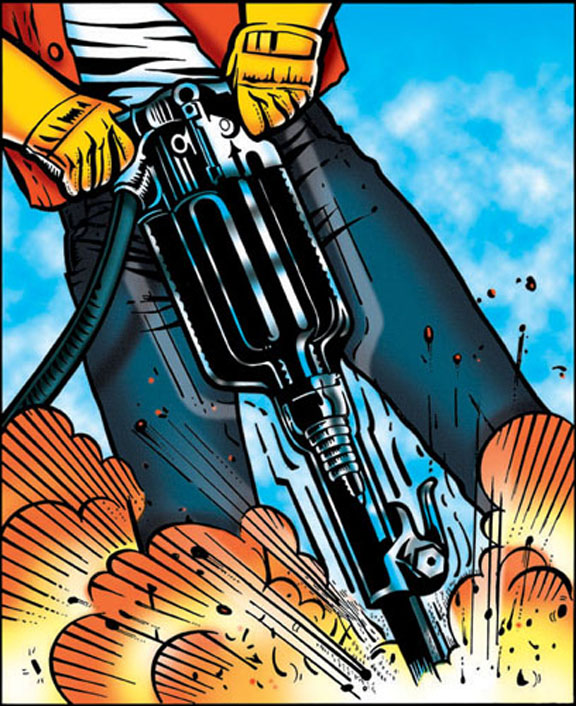
Thanks for the good question Adam. I was just talking to a friend about this very question. He thought that his Jumbo Java mouthpiece was blowing out his ears. I found some interesting answers to your question. Babies do have more sensitive hearing due to smaller ear canals, the decibel levels that they can take are slightly lower than adults. That said, a babies cry can easily hit 115 on the decibel meter, far above the safe level of 90 decibels. Saxophones aren't much louder than 100 decibels, maybe an Otto Link metal 9 might get you up to 105 decibels if you play triple forte. Adults can take 90 decibels for up to 8 hours safely. If you were to practice for 8 hours at triple forte in the same room with a screaming baby then you both should wear some good earplugs. Hearing loss is very common among musicians, and you would think babies, but there are ways to prevent it. Invest in some good earplugs made for musicians, these will allow you to hear well enough to play while protecting your hearing. If you're playing in the same room with your baby at a mezzo-forte for an hour or two at a time, your baby should be fine as long as you don't blast or play for hours at a time. If you want to be overly cautious you might consider using some wax in your baby's ears and earplugs in yours. Remember that cute little baby of yours can do more damage to your hearing than a jackhammer, so next time you're changing a diaper you may want to think about putting in some earplugs. It seems like you should put earplugs in a crying baby's ears too.

Don't take chances with your hearing! Be especially careful when you go into the recording studio. My teacher Ray Brown had his hearing severely damaged by a bad engineer's headphone mix.
Don't wait until your ears hurt before taking action. Hearing damage can be almost instanteous or it can be cumulative over years. Either way, musicians can't afford any hearing loss. DCV

Question: Which sound has greater potential to damage your hearing - a baby's cry or a jackhammer? If you answered the former, a baby's cry, you were right, according to information provided by a representative of the Center for Hearing and Health.

At 115 decibels, the sound of a baby's cry can begin to cause hearing damage to a person next to the child after just 15 minutes, reported Dorie Watkins, an industrial audiologist for the Center for Hearing Health. The jackhammer doesn't quite measure up, measuring "only" 105 decibels, she noted; but that level of sound also can cause damage to the inner ear after one hour, according to medical and science standards.


Decibel Levels of Daily Noises

NIOSH has compiled a list of the decibel measurements (dBA) for common noises you might be exposed to each day at home, work or during recreational activities. A decibel is a unit that expresses intensity or power. See what your exposure is to unsafe noises with some of the following examples:

Home:

  • 50 dBA - Refrigerator
  • 50-80 dBA – Electric shaver
  • 50-80 dBA – Electric shaver
  • 60-95 dBA – Hair dryer
  • 75-85 dBA – Flushed toilet
  • 80 dBA – Ringing phone
  • 110 dBA – Crying baby
  • 135 dBA – Noisy squeeze toys

Work:

  • 40 dBA – Quiet office/ library
  • 65-95 dBA – Power lawnmower
  • 90-115 dBA – Subway
  • 105 dBA – Snow blower
  • 120 dBA – Ambulance
  • 140 dBA – Airplane take-off
  • 180 dBA – Rocket launching from pad

Recreation:

  • 70 dBA – Freeway traffic
  • 95-110 dBA – Motorcycle
  • 110 dBA – Car horn
  • 117 dBA – Football game (stadium)
  • 150 dBA – Firecracker
  • 157 dBA – Balloon pop
  • 170 dBA – Shotgun

Other:

  • 0 dBA – Softest level the human can hear
  • 10 dBA – Normal breathing
  • 60 dBA – Normal conversation
  • 110 dBA– Shout in the ear
  • 120 dBA – Thunder
How Much is Too Much?

NIOSH states that the maximum amount of time a person can be exposed to 85 dBA without experiencing hearing damage is 8 hours; this is the average level of noise a person hears every day. However, continuous exposure to 85 dBA beyond the 8-hour limit will cause hearing loss. If a person is exposed to level above 85 dBA, the risk of hearing loss increases in a shorter amount of time. The maximum time allowed for 110 dBA (e.g. a crying baby) is 1 minute 29 seconds. If a person is exposed to a noise that has a measurement of 140 dBA (e.g. airplane departure), immediate inner ear damage would result.


How loud are the activities that you enjoy?

Some Examples of Dangerously Loud Recreational Activities

  • Noise levels at video arcades can be as high as 110 dBA.
  • Firecrackers create sound levels from 125 - 155 dBA at an average distance of 10 feet.
  • Sound levels at live music concerts can be measured at 120 dBA and beyond.
  • The noise level of gunshots can be measured at 150 dBA -167 dBA and hearing loss can result from just a few shots of a high powered gun, if appropriate hearing protection is not worn.
  • Noise levels at movie theaters have been measured up to 118 dBA.
  • Sound levels in health clubs and aerobic studios can be as high as 120 dBA.
  • Personal stereo systems with headphones produce sounds as loud as 105 - 120 dBA if turned up to maximum levels.
  • Sound levels at a sporting event can be measured up to 127 dBA.
  • Motorboats emit sound levels ranging from 85 - 115 dBA.
  • Motorcycles have been measured at levels ranging from 95 - 120 dBA.
  • Noise levels of snowmobiles are as high as 99 dBA.
  • Many children's toys emit sounds which are measured at 135 dBA -150 dBA.
  • Noise levels from 'Boom Cars' have been measured at 140dBA and beyond."

Casa Valdez for the Jazz Harmony student

The nature of blogs and the fact that the Blogger search engine sucks makes it difficult to locate information on Casa Valdez. There are articles that I think are very important for my students that are lost in the archives. I have written about many of the topics that I usually deal with in my private and group lessons. There are some topics that I always teach, and in a certain order. For those students that may not currently have a teacher, or just want to suplement their other studies, I will try to lay out a course of study from the material on this blog. This rough outline is aimed at the Jazz improvisation student. This is simply a suggested course of study, feel free to develop your own.

Jazz Harmony for Improvisation: chord-scales
Berklee Harmony 1-4
Digital Patterns
Symetrical Scales: diminished and whole-tone
John Stowell's melodic minor scales for improvisation
Ray Brown Patterns
Paul Contos ii- V7 patterns
Motific Development
Tim Price's Blues Studies
Lee Konitz 10 Level system
Bob Mover's ii-V7 subs
Basic ii-V7 substitutions
The best ii-V7 substitution ever
Half Step subs/related ii-7s part II
8th note lines and practice tips
Randy Porter's Bebop harmonic devices
Modes of the Harmonic Minor Scale
Gary Campbell's Triad Pairs for Jazz
Triad Pairs and the modes of Harmonic Minor
Special Function Dominant Chords
Pentatonic Lines
Jof Lee's Polychord overview
Mulgrew on Woody Shaw- the 'Blue Major third'
George Russell's LCCOTO
Tim Price's random line excercise
Coltrane Chord Substitutions