4/18/12

Jazz bari sax transcriptions at jazzbarisax.com

At jazzbarisax.com you can download 45 free bari transcriptions by players like Mulligan, Adams, Smulyan, Cuber and Brignola. Makes me want to find myself another bari.

Jazz Bari sax transcriptions

4/16/12

George Garzone's Random Chromatic Approach

George Garzone
 Jody Jazz released a two DVD package on George Garzone's Triadic Chromatic Approach a while back, which I did an extensive review of on this blog. The DVDs covered two main concepts, the Triadic Chromatic Approach and the Random Chromatic Approach. The first, the TCA, is a way to created 12-tone lines on the fly. I wrote a few TCA etudes to illustrate this concept, see links below:
Etude 1
Etude 2
Etude 3

The other main concept is the the Random Chromatic Approach, something I did not write much about and I think it is worth considering. The RCA can be thought of as a Post-Bop chromatic approach (as opposed to a Bebop chromatic approach). The Bebop chromatic approach, or 'enclosure' as some educators like to call it, is a way to link ideas together, add interesting directional elements and to give more forward motion to a line. Below are a few examples of Bebop approaches from Steve Neff's Approach Note Velocity book:

Bebop lines just would not sound like Bebop without this essential element and every student of Bop would do well to spend plenty of time working this. First start out with the simplest approaches and work on approaching any given chord tone with every type of approach. One could even argue that armed with only a knowledge of chords and Bop approaches a player could create a compelling Bebop solo without ever learning chord/scales.

Garzone has an interesting take on the chromatic approach, and it is quite an easy, especially compared to the difficulty of his Triadic Chromatic Approach. Below are a few pages from Garzone's ebook that comes with the TCA DVD.


(click the above graphics for a larger version)
If you follow Garzone's guidelines you will end up with very modern sounding chromatic lines that have a lot of forward motion. These random chromatic lines serve to same purpose that traditional Bebop chromatic approaches: they give lines interesting direction, they link ideas together and they add forward motion to the line.

In the TCA DVD Garzone has several play-along tracks where he trades fours, giving the student a chance to respond to his phrases. A former student of mine in Japan transcribed George's fours from the DVD and it is quite interesting to see exactly how he constructs his chromatic lines. George doesn't strictly follows his own rules (also the case when it comes to his TCA), so do not be surprised if you do not see the concepts from the PDFs above strictly applied.


I highly recommend both of the Garzone/Jody Jazz DVDs to any student looking to add more modern concepts to their playing. Also worth noting is the fact that Jody has drastically cut the price of the TCA DVD since it was first released.


4/5/12

Freddy's Guide to Creative Improvisation

First off I want to apologize for slacking off on posting here. I was out with a cold for a while and then taxes have been looming. Most of all I've just been very lazy. I do have a lot of things in the pipeline, so please bear with me here while I struggle to get my ass in gear.

 There have been a ton on new multimedia Jazz educational products coming out lately. It seems that the Jazz world is really starting to take full advantage of the digital age, better late than never I guess. Some of these products are online video lessons, some are play-along CDs, and some are full interactive multimedia DVDs.

 One of my teachers when I was at Berklee who was a big influence on me was Fred Lipsius. I posted an interview with Lipsius a while back. I took several ensembles with Fred, so I didn't get a lot of material directly from him other than getting to listen to him play, which was inspiring in itself. I really got to understand his concepts through studying his books. In 1986 Warner Brother's published an incredible book that Lipsius wrote called The Complete Book on Creative Improvisation. That book was a goldmine of material for me and shaped the way I thought about Jazz improvisation to this date. It was was worthy of being called 'the Complete book' because is covered so much ground. It had a ton of great musical phrase and licks in every key and for chord type and then it went in to great depth on how to manipulate, develop, and apply these licks to all different types of musical situations. Lipsius really presented a high flexible and creative alternative to the typical rote memorization approach that is too common in Jazz education. The licks in the book were all super hip, but the important thing was to see how to take any existing musical idea and apply it in numerous ways over different harmonic situations.

 Lipsius' Complete Book on Creative Improvisation went out of print shortly after it was first published and after loaning my copy out I was never able to get my hands on another one, though I saw a few on Amazon for upwards of $100. I was quite excited to hear that Fred had released it again himself, this time is in full multimedia format. There are hundreds of videos online on 3 DVDs that feature Lipsius playing individual musical ideas, talking about what he was thinking about when he came up with them and how to apply each one. You can also now buy a hard copy of Lipsius' book for $19.95.

Below are a few pages from the book to give you some idea of the kind of material it offers. One of the most interesting things about the book in my opinion is how much Lipsius focuses on motivic development, a topic that is usually under emphasised. You can click on any of the pages below to get a larger version.


Fred also deals a lot with how to apply the same musical idea to many different harmonic situations. Here are a few pages dealing with Blues scale applications:


Here is a chapter dealing with Tri-tone subs:


Here is the official press release for Freddy's Guide to Creative Improvisation :

Music Students and Professional Musicians Get More Creative And Learn How To Be A Great Improviser With Online Video Training for the PC, Mac, and iPad at Freddy’s Guide To Creative Improvisation: www.FreddysGuide.com

Freddy’s Guide To Creative Improvisation features Berklee College of Music professor Fred Lipsius who is a two-time Grammy Award-winning musician and original band member of Blood, Sweat & Tears with 9 Gold Records. The training is available now at FreddysGuide.com for the introductory price of $49 (price will change to $99 on Jan. 22nd) and provides one whole year of 24/7 access to over 300 video clips of Fred Lipsius teaching from his book on Creative Improvisation.

 For music students and professional musicians eager to become great improvisers, online training has finally arrived via Broadband Internet for the PC, Mac, and iPad.  Educational multimedia publisher, ETERNAL WAYS, has partnered with Berklee College of Music professor, Fred Lipsius, to help musicians on any instrument unlock their creative potential for improvisation: online music instruction with hundreds of licks, scales, techniques, exercises, and solos to teach anyone how to be a great improviser. Playable 24/7, this online portal at http://www.FreddysGuide.com allows students and professionals to learn what they want, when they want, and at their own pace for a full 365 days. All that is required is Internet access and a basic knowledge of chords and scales.

“Our goal was to create a low-cost, simple and friendly online learning experience that allows any musician, from any place in the world, to access Fred’s interactive video instruction for an entire year. Becoming a great improviser takes a lot of time and practice which is why the training is available for 365 days. It is like having your own private instructor on-demand.” says John Pritchard, Founder and Creative Director of ETERNAL WAYS. “In addition to being one of the world’s greatest improvisers, Fred is an outstanding instructor who has been teaching at Berklee for over 25 years. His book on Creative Improvisation is second to none.”

Here is what legendary musician, Randy Brecker, has to say about Fred’s book: “This is one of, if not, the most comprehensive book on improvisation that I have yet encountered. The student (or professional) is led systematically into getting beyond the rote learning of patterns and cliches, into understanding the spontaneity and creativity that is true jazz improvisation.” Randy has played trumpet with The Brecker Brothers, Blood, Sweat & Tears, Steely Dan, Charles Mingus, Bruce Springsteen, Frank Zappa and many more.

Eddie Gomez, bassist for Miles Davis, Bill Evans, Dizzy Gillespie, Benny Goodman, and Herbie Hancock says, “Fred Lipsius has written a clear and comprehensive study on the art of improvisation.”

Paul Shaffer, Musical Director of the Late Show with David Letterman, calls Freddy’s Guide to Creative Improvisation “An eminently usable reference from a brilliant cat!”

Adam Holzman, keyboardist for Miles Davis, Wayne Shorter, Grover Washington and Faculty member of the New School
for Jazz and Contemporary Music, NYC says, “Freddy's Guide To Creative Improvisation is an original and exciting method for teaching what is almost unteachable: the art of improvisation. A well thought-out and balanced approach.”

The online training is designed for all instruments and works on any computer with a broadband connection. It plays especially well on the iPad and the video looks and sounds great, even on the iPhone.

Price: $99/yr
Special discounts are available for music teachers/instructors/schools with 10 or more students.

The 188 page book is included as an eBook (PDF format for high resolution screen magnification and printing) and is also available separately in print for $29.99. A 3 Disc DVD Series of the training features licks, techniques, and solos for $99. 

If you are a musician who wants to learn from a pro, Freddy's Guide To Creative Improvisation contains everything you need to know about improvisation! Freddy unveils the mystery of creative improvisation to help you become the great improviser you can be.


To learn more and sign up to get your own password, go to www.FreddysGuide.com

3/5/12

Chris Potter's solo on Confirmation

Chris Potter offers lessons through the ArtistShare web site. If you can't afford to fly to NYC to study with Potter in person it's a nice alternative. Saxophonist/educator Adam Roberts has transcribed Potter's solo on Confirmation from the ArtistShare lessons. The solo is nine choruses long and must have been a bitch to transcribe. Adam also gives a short chorus by chorus analysis of the solo.

Thanks Adam!

Confirmation- Chris Potter's ArtistShare lesson

2/26/12

Charles McPherson live at PDX Jazz Festival


 The PDX Jazz festival is happening this month here in Portland. It seems the number of national acts was significantly scaled back this year, probably a common trend these days. Don Lucoff recently took over as the director of the festival and seems to be running things a bit differently. Don seems to think that every performance should have a theme. Maybe it's from his years of doing promo work, or maybe it's just that he wants to feel like he's actively 'artistically directing' the musicians. For example he asked George Colligan to make the theme of his performance 'the music of Andrew Hill'. This was George's first big show after moving to town and I would guess that, although George enjoys Andrew Hill's music, he wouldn't consider Hill to be an influence on his playing.

  Was Lucoff thinking that Portland listeners would be more likely to come to see George play if they thought there would be some Andrew Hill music involved? Colligan is a prolific composer in his own right and I'm sure he would have much preferred to play his own composition (which he ultimately ended up doing), rather than Hill's music. Don suggested themes to many of this year's festival performers. Some of this year's themes were: 'The Lure of the Jazz Lyric', 'Classically Carmen', 'For Portland Only', and 'PDX Afro-beat Breakdown'.  It whole idea just seemed pretty forced to me. When you let marketing considerations dictate the choice of material the musicians play on the shows that you book then you are limiting the freedom of the musicians to choose what kind of material they play, and ultimately the degrading the quality of the performances. Let the musicians dictate the material that they feel will be the strongest representation of what they do. They know what kinds of tunes they sound best playing. Let the theme of the festival and of each performance just be 'The best possible music that each performer can present'. Why try to shoehorn players into the shoes of the Jazz masters?  I do however think that bringing in a seasoned Jazz PR pro managing the PDX Jazz Festival was a smart move. Enough with the themes though.

 The performance I was looking forward to the most was Charles McPherson's 'Tribute to Prez (the show was on President's day after all) and Bird'. Isn't every one of Charles' shows a tribute to Bird really? It wasn't a stretch, but why ask Charles to limit his choice of material to tunes that Bird or Prez played? The house was packed, but they were there to hear Charles, not because they were hoping to hear Lester Leaps in or Star Eyes.

 If I had to choose one favorite living Jazz saxophonist it would be Charles McPherson, no contest. I first heard him when I was still a teen and I remember being totally floored by his playing. First of all Charles has and incredibly beautiful and huge alto sound, with the best qualities of Bird's tone. The next thing you notice is his malleable time feel. He just floats on top of the time, constantly shifting between different metric modulations and then occasionally drops into to some extremely hard swinging 8th note lines.  Actually, 'metric modulations' isn't even the best way to describe what Charles does because it sounds so much more organic than that. A more accurate way to describe what Charles does with time would simply be bad-ass. I don't know of anyone else who does what he does with time.

 Charles doesn't leave a lot of space, and I mean that in a good way. Let's just say that if he were paid by the note he'd be a very wealthy musician by now. His concept is kind of like a Bebop version of Trane's 'sheets of sound'. Charles is constantly coming at resolutions from different directions, circling around changes like a swarm of angry hornets. From what I can tell, he seems to be using some of Barry Harris' harmonic concepts, including lots of diminished substitutions (like Trane did in his Sheets of Sound period). He has a classically Bebop vocabulary, but he is definitely applying a lot post-bop harmonic innovations and chord substitutions in his approach. I even heard some lines from Slonimski's book sever times during the evening. One thing about Charles' approach is that he doesn't hold back, he goes for it all the way. I love when players are like this. I want to hear someone really go for the gusto, balls out. Forget sounding clean and controlled. I want careening and out of control. I want to hear some carnage, some cracked altissimo notes, some collateral damage! Charles is raw, but he certainly still sounds polished. The beauty of his sound seems to allow him to get away with the wildly aggressive and dense playing he puts out.

 I had a chance to talk to McPherson before his set at Jimmy Mak's. He told me that he was playing on a modern hard rubber Meyer 6. Nothing special really. I've heard that Charles is always experimenting with different pieces. Last time he was playing in Portland I think he was playing on an older Meyer, maybe a Meyer Brothers or a NY Meyer. He was still using a Vandoren Optima ligature this time. When I heard him last I was amazed at how big his sound was. I just couldn't see how he could be getting such a huge sound playing a Meyer 5 or 6, so I had to try the ligature that he was using. What else could it be? He isn't a really big guy, so how did he do it?! I ordered myself an Optima ligature as soon as I got home....and...what do you know, it sucked. Didn't make my sound any bigger, just a little brighter.

 Before the PDX show Randy sat with Charles and had a 'conversation' (thanks to Don and actually a good idea). Charles talked about the fact that he thinks of time not as something to 'play with', rather as something to 'play against'. This idea isn't as common among players and educators as you might think. Many teachers try hard to impress on students the need to always 'lock in' to the time. McPherson creates a high degree of rhythmic tension by floating out of time, but he always comes back 'inside' and swings his ass off just long enough for his listeners to catch their breaths. Then he's off like a Bebop banshee again. The late Jimmy Mosher, one of my first teachers, was one of the few saxophonists that had a time feels as elastic as McPherson. That is not surprising because McPherson was one of Mosher's biggest influences, another was Charlie Mariano, who also had a loose time feel. I posted some great bootlegs of Jimmy Mosher's live shows a while back.

 I bootlegged McPherson's set with my Zoom digital recorder. I was sitting at a table that was basically right in front of the stage, so the recording came out pretty well. Charles played six tunes, which were all crushing. I asked him for his permission to post the recording here and he suggested that I post a few tunes, rather than the entire set. I choose his renditions of I'll Remember April, Embraceable You, and Cherokee. I also recorded McPherson's conversation with Randy Porter, which is quite interesting. The local rhythm section Charles used is Randy Porter on piano, Tom Wakeling on bass and Alan Jones on drums.

Enjoy!


Charles McPherson live at Jimmy Mak's- PDX Jazz Festival 2/20/12

Charles McPherson's web site
Charles McPherson interview
YouTube interview from San Diego Jazz Profiles- part 1
YouTube interview from San Diego Jazz Profiles- part 2
YouTube interview from San Diego Jazz Profiles- part 3
YouTube interview from San Diego Jazz Profiles- part 4

2/16/12

David Valdez/George Colligan Latin-Jazz Quintet live

On Feb.15th George Colligan and I played a Latin-Jazz gig at Ivories. Here are a few tunes from that gig.
Lydian Domination

Miriam Edward's New York Accent

Common Man

Ghostland

(These are large files and may take a minute to load in your browser)

Personnel:
David Valdez- alto saxophone
George Colligan- piano, composer
Dave Captein- bass
Todd Strait- drums
Chaz Mortimer- percussion

2/14/12

Jody Espina interview- new Jazz education products

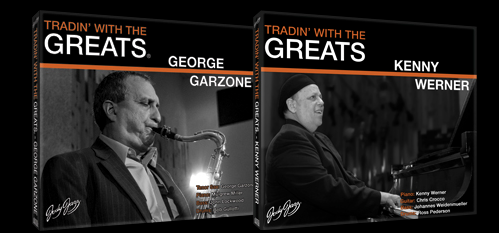
 Jody Espina is the man behind Jody Jazz saxophone mouthpieces. Recently Jody has started producing some very interesting Jazz educational multi-media products. The first was a two DVD set featuring George Garzone's Triadic Chromatic Approach, which I reviewed here. Next Jody put out two play-along CDs featuring George Garzone and Kenny Werner called Tradin' with the Greats. Each one of these volumes is a two CD set. The first CD has George or Kenny playing the melodies and then trading choruses (leaving open spots for you to play) and the second CD has no melodies or trading.

 A lot of my own practice time is spent playing Aebersolds, so I was excited to try out Jody's new play-alongs. I really enjoyed the Tradin' with the Greats CDs, they were much more interesting and inspiring than working with Aebersolds. One big difference is that the bass and drums are not hard panned right and left, which makes the recording sound much more natural to play with. The CDs come with PDFs of all of the tunes in concert, Bb, Eb and bass clef. The first thing you really notice about these play-alongs is the high quality of the recordings and the level of musicianship. You get the feeling that the band wasn't just in the studio on auto-pilot with the awareness that there would be high-school kids playing to the finished tracks. These actually sound like good albums. I let a few of my students borrow these volumes and they loved them.

  The newest product that Jody released is the second Garzone instructional DVD set called In the Funk Zone. This volume deals with pentatonic scales and the musicians on the DVD are George Garzone, Mike Stern, John Patitucci, Rollins Ross and Kenwood Dennard. Garzone's TCA DVD was aimed at the advanced player, but this new pentatonic CD is definitely appropriate for all levels. In the new DVD George demonstrates how to use different pentatonic scales over straight forward Funk grooves, always stressing good time. Then he demonstrates how to move outside by side-slipping, using altered pentatonics and other techniques. Below is one example from the ebook:
click above graphic for larger version
  There are quite a few books on using pentatonic scales for improvisation on the market. I'm kind of a theory nerd, but Bergonzi's Pentatonics book makes my eyes glaze over in about two minutes. Garzone's DVD is very accessabile and has some unique approaches to using pentatonics, plus it's a lot of fun to Funk out with such a great rhythm section.

  I highly recommend all of Jody's new educational materials. They are well-thought out, original, have excellent production values and are they are a blast. Jody has drastically dropped the prices of these new volumes, so they offer great value for the money as well. The In the Funk Zone double DVD set is only $34.95 and the Tradin' with the Greats double CD sets are just $19.95 each or $37.50 for both volumes.

I interviewed Jody about his new products when I was at NAMM in January. You can hear the utter bedlam of NAMM in the background.

Here is my interview with Jody Espina.

Jody Jazz website

Jazz Truth interview

If you haven't checked out pianist George Colligan's great Jazz Truth blog yet then you are missing out. This Wednesday George and I are co-leading a Latin-Jazz quartet at Ivories Jazz Lounge here in Portland, so George decided to interview me for his blog to help promote our gig. Here is the interview.


2/8/12

Doug Web demonstrates the Tubax

One of the more interesting things I saw at this year's NAMM show was the Tubax, an Eb contra-bass saxophone one octave lower than the bari. Tuba+Sax+Tubax.

 The thing was abut as tall as a regular bari, except that it had more coiled tubing. The interesting thing about it was that the action on the right and left hands are almost parallel. It seems that Oleg is importing the Eppelsheim Tubax and stenciling his name on it. The retail price runs at just $30k for the big horn. Doug Webb, one of L.A.'s top saxophonists, was demonstrating the Tubax at NAMM. He told me that he had had one for several years, buying his when the price was somewhat lower. I would absolutely love to own one of these bad boys, but I'd also love to pay off my mortgage.

I recorded Doug playing the Tubax with my digital camera. Unfortunately my little camera wasn't built for the massive low frequencies that the Tubax puts out, so please forgive the peaking.


Here is another video of Doug demonstrating the Oleg tenor:

2/1/12

Jazzenzo- Jazz scores & transcriptions

Jazzenzo Jazz magazine has a page with a ton of scores available for free. George Colligan hipped me to this site, there are over 50 of George's tunes on the site. There are also tunes composed by Nguyên Lê, Bud Powell, Chris Cheek, Sam Rivers, Seamus Blake, Mark Turner, and Kurt Rosenwinkle, as well as a lot of European composers.

Jazzenzo Free Jazz scores and transcriptions

1/26/12

NAMM madness

If you've ever been to NAMM you know that it is insane. It's like being in a war zone, but with thousands of freaks. Well, of course there are plenty of normal looking music store owners, instrument markets reps and a few haggard looking Jazz musicians, but it is a truly a great place for freak and hootchie mamma spotting. I saw groups of leather clad guys with matching grey reptile eye contact lenses, hordes of surgically enhanced Goth Death Metal mini-skirt/fishnet wearing spokes models, EVEN the SEXY SAXMAN was making the rounds. That guy is killing, so killing.

  Let's not even get into all the tattoos, which made the Hell's Angels at Sturgis look like librarians in comparison. It was a scene, to say the least. I ran into old friends that I hadn't seen in years and was able to meet people that I'd only know online. Schmoozefest!!

 This year I tried getting some video on my camera, which didn't turn out to work so well for loud music. Please excuse the peaking on some of these.

Here is some sort of strange percussion instrument. Remember to THINK OUTSIDE THE DRUM.


Always a good way to attract a crowd to your booth:


Who needs a drummer anyways?


Do you have an iPhone and have always wanted to play the Ukelele but were too lazy to learn?


Mighty Bright Orchestra Light review

One of the things I was on the lookout for at NAMM was a really good stand light. I have a small battery powered LED light and an AC powered Manhasset light, but the first isn't bright enough and the second has a cord and a breakable bulb. I went to many different booths before I found one that had everything I was looking for, this turned out to be the Mighty Bright Orchestra light.  The MB Orchestra Light is very lightweight and comes in a durable soft travel bag. The light has a bank of nine bright white energy-efficient LEDs and the bulbs are made to last over 100,000 hours.

 The two features that really sold me were the dimmer setting and the back fin, which directs the light away from the audience and back onto the page. On the high setting the light (lasts 14 hrs on two AAs) will light up to four pages of music and the low setting (20 hrs) is nice when you don't want to light the up entire room. The light also comes with an AC adapter with 13 feet of cord in case you run out of batteries. The grip on the base is large, sturdy and padded.

All in all, this is the best stand light I have ever seen.

Mighty Bright Orchestra Light
Retails for $74.99

1/25/12

NAMM 2012 and the L.A. Jazz Collective

Last weekend was the NAMM convention. It was my second time going down to SoCal for the convention and was a lot of fun seeing old friends, checking out all the new products, and witnessing all of the freaks on display. I got down to L.A. on Wednesday and played at a club in Little Tokyo called the Blue Whale that night. The gig was part of a weekly residency at the club by the L.A. Jazz Collective, which is a group of musicians who have banded together to produce regular performances of creative Jazz music. Here's what the LAJC website says about the organization:
Members of the LAJC
The Los Angeles Jazz Collective is a group of musicians working together to build a stronger jazz community within Los Angeles. Through cooperative effort and education, we seek to promote our work and generate greater public appreciation for improvised music. The LAJC's membership includes many of the area’s talented younger artists, including pianist/organist Joe Bagg; saxophonists Matt Zebley, Robby Marshall and Damon Zick; drummer Jason Harnell; bassist Ryan McGillicuddy; trumpeters Brian Swartz and Josh Welchez, and guitarists Steve Cotter, Jamie Rosenn, and Mike Scott. There are currently 13 core members and a growing number of associate members. The collective has held meetings several times each month since November of 2007 and has already established a strong sense of community within the membership. Many members are on the faculty at various colleges and schools, and the collective intends to integrate enthusiastic students into this community. The LAJC aims to be a catalyst for those who play modern, creative jazz to represent the pioneering spirit that is the essence of the jazz tradition. The collective is compelled to live out that spirit by forging ahead in it’s members’s own compositions and performances.

Matt Otto, one the the group's founding members told me that at the beginning they send out around 200 emails to local Jazz musicians to see who was interested and they got about twelve responses.  The LACC recently got their nonprofit status, the next step is applying for grants. They plan to create educational programs and more concerts with those grants.

 I played a few sets at the Blue Whale show with Matt Otto and a host of other great players, including Gary Fukushima, Tim Pleasant, Jamie Rosen, Gilad Hekselmen, Tina Raymond, and Dave Robere. Here is a link to a recording and PDFs of one of the tunes we played, a killer head that Matt Otto wrote over the changes to Alone Together called Her Legato Note.

The LAJC website
Blue Whale Jazz club
Matt Otto.org

Stay tuned for plenty of product reviews, videos and pics from my 2012 NAMM trip.

1/11/12

Michael Brecker Live Recordings website

Emily, Mike, Randy & Santa
Michael Brecker continues to be one the the most respected and emulated saxophonists of our time. The other while perusing Facebook I saw so many people posting Brecker YouTube videos that for a minute I though it might have been some sort of national Brecker holiday, nope, everybody just loves Brecker.

Do you need your three-tonic fix first thing in the morning?  Is your Guardala metal piece not giving you enough of that Brecker magic? Do you feel like you need to go back in the shed and practice some Brecker transcriptions for a few thousand more hours? Do you fall asleep thinking about new patches for your EWI? If so then you then you need to check out the Michael Brecker Live Recordings website. Luis Gerrits runs the site and appears to be the world's foremost authority on all things Brecker. He has the largest collection of Brecker bootleg audio and video on the planet, and he is willing to trade you if you contact him.

To me the most interesting thing about Gerrits' site is his collection of transcriptions, many of which were done by Rick Margitza. You can download all 95 of these Brecker transcriptions for free here.


1/3/12

Neck Strap hook analysis results

  Several weeks ago I posted here and on SOTW that my new Just Joe's neck strap (with a large brass hook) noticeably changed the timbre and volume of the sound of my saxophone. This kicked off a long debate on SOTW in which many people scoffed and said I was crazy (or that my ears were deceiving me). Most of those SOTW members who believed my claims had not even bothered to try the large brass hook test themselves. Some of these players were well respected saxophonists and authors and many of them were weekend warriors. I was totally convinced that the large brass hook on the neck strap brings out certain overtones, on some notes more than others. It was perfectly clear to my own ears, which at this point in my life I tend to believe. About 80% of the saxophonists who tried the hook comparison test also believed that it made a difference. The 20% who did not hear any difference were usually either very inexperienced players or experienced players who were totally convinced before they even tried the test that it was impossible that a brass strap hook could change the sound of the horn. There were admittedly a few serious players who didn't notice a difference and seemed to have an open mind about the idea, like Ellery Elskelin. My theory is that the different makes of saxophones have the strap hook in different places, which causes different degrees of effect because the hooks may not be sitting right at a vibrational node. This means a large brass hook may have a greater effect on a Selmer than on a Conn.

  My testing with different saxophonists wasn't very scientific, so I turned it over to some pros. I have a saxophone student named Randal LeNeve who is an engineer at Rodgers Instrument corporation (which manufactures organs and is a division of Roland) and has a Masters degree in physics. Randy noticed a significant difference in the brass strap and was just as puzzled as I was about why a hook could make a difference in the sound. One theory that Tom Garcia and Sammy Epstein (who taught acoustics at Berklee) had at first was that the difference in timbre was more noticeable to the player because of the increased vibrations traveling up the strap to the players jaw and ears. This theory was shot down by Randy because of the fact that neck strap cord is a poor acoustical conductor. One of Randy's theories was that the large brass hook acts as what he called a 'resonating antenea'. This means that the hook itself puts off extra higher frequency overtones when the horn is played. Randy also thought that the point on the horn where the strap ring sits could be right at a critical vibrational node of vibration, which could explain the greater difference of change to particular notes on the horn. One thing that Randy really stressed was just how acoustically complicated the saxophone is. Just the driver (mouthpiece & reed) alone is highly complex and unpredictable. The instrument is actually quite mysterious and even scientists are not totally clear on some of the details of its workings.

  Randy took the Just Joe's strap into the Rodgers labs, enlisted the help of his colleague John Pospisil and they did some testing. John also heard a noticeable difference between the Joe's strap and a strap with a plastic hook and, being a saxophonist himself, was intrigued enough to join the project. They tested the Just Joe's strap against a strap with a plastic hook and one with a small thin steel hook. Randy played alto and soprano and John was the recording engineer. Randy tried his best to play as close to the same volume on all of the tests and they recorded eight different notes on each horn. John used the Roland R09 recorder, sampling at 24-bit, 48kHz and analyzed the frequencies using Sony Sound Forge, using a Blackman-Harris algorithm with 65,536 sampling points.

They found that the Just Joe's strap amplified some of the higher partials. It also appeared as if the strap eliminated a small amount of the frequencies between the overtones, which might account for a 'clearer sound' (this is my theory). Their conclusion was this:
"Certain notes on the Alto showed higher peaks on frequencies above 6 kHz which implies that the harmonic ratios of sound pressure levels are being altered i.e. a change in the timber of the sound, not the frequency distribution. Also G# on the Alto showed considerable added frequency content starting at about 200 Hz. The Soprano shows considerably more frequency content above 10 kHz for some, but not all notes.  It is perceivable that the Just Joe's Saxophone Gel Strap has an impact on the frequencies at or above 10 kHz for the Soprano sax setup used in this experiment and on certain notes on the Alto sax on frequencies above 6 kHz and in one case for G# starting as low as 200 Hz."
Randy added:
 "So in the case of Joe's Neck Strap the report shows that certain harmonics of the fundamental frequency were amplified. This means that those notes are LOUDER and the TIMBRE of the note was altered. That is, the horn still sounds like a saxophone but has 'brighter' and 'louder' harmonics. The LOUDER is pretty obviously a good thing. The TIMBRE being brighter can depend on what a player wants." 

Here is one of the screenshots from the analysis. It is middle A on the alto:
click on above graphic for a larger view

 They also felt that further testing would help to make these results more concrete and that these tests might include:
  1. Recording several takes of each note using each strap and averaging the frequency response of the resulting recordings.
  2. Using several straps to compare the differences in frequency response between each strap.
  3. Recording in a more acoustically "dead" environment.
  4. Using several microphones for recording including contact microphones on the saxophone body.
  5. Determination of the fundamental frequency and harmonic distribution of the metal piece(s) on the strap itself when not attached to the saxophone.

 So although this question should be investigated more thoroughly to discover exactly what is causing the difference in timbre between the Just Joe's strap and a typical strap (with a plastic or small steel) hook I feel like I have been vindicated by the testing that was done in the Rodgers labs. No amount of scientific testing be enough to convince some who are convinced that a strap hook cannot change timbre, so I fully expect that this post will set off another 20 page thread on SOTW. Fortunately I will save myself the aggravation and not be reading that thread. I had the wisdom to have my SOTW membership suspended indefinitely.

If anyone is interested in reading the full report from the Rodgers labs email me and I'll send you a copy.


I can say this will a fair amount of certainty though......

There is a difference in timbre!


Just Joe's Neckstrap